




Overview
AI Agents in Pipefy now support a third knowledge source type: Plain Text. Lightweight business rules, operational instructions, and static context can be added directly in the agent interface, with no file uploads and no database connections required.
What's new?
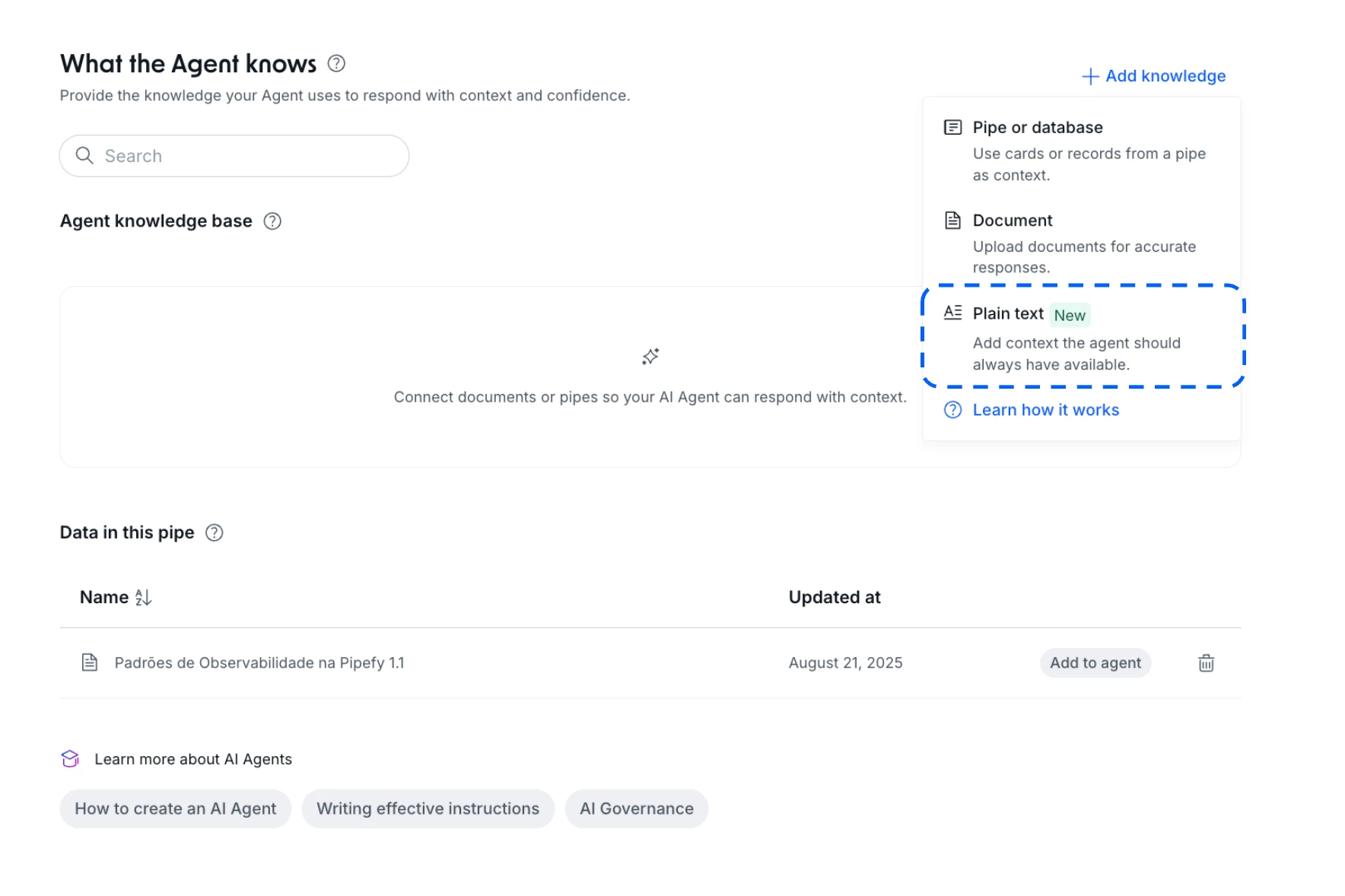
- New Plain Text knowledge source option available in agent configuration
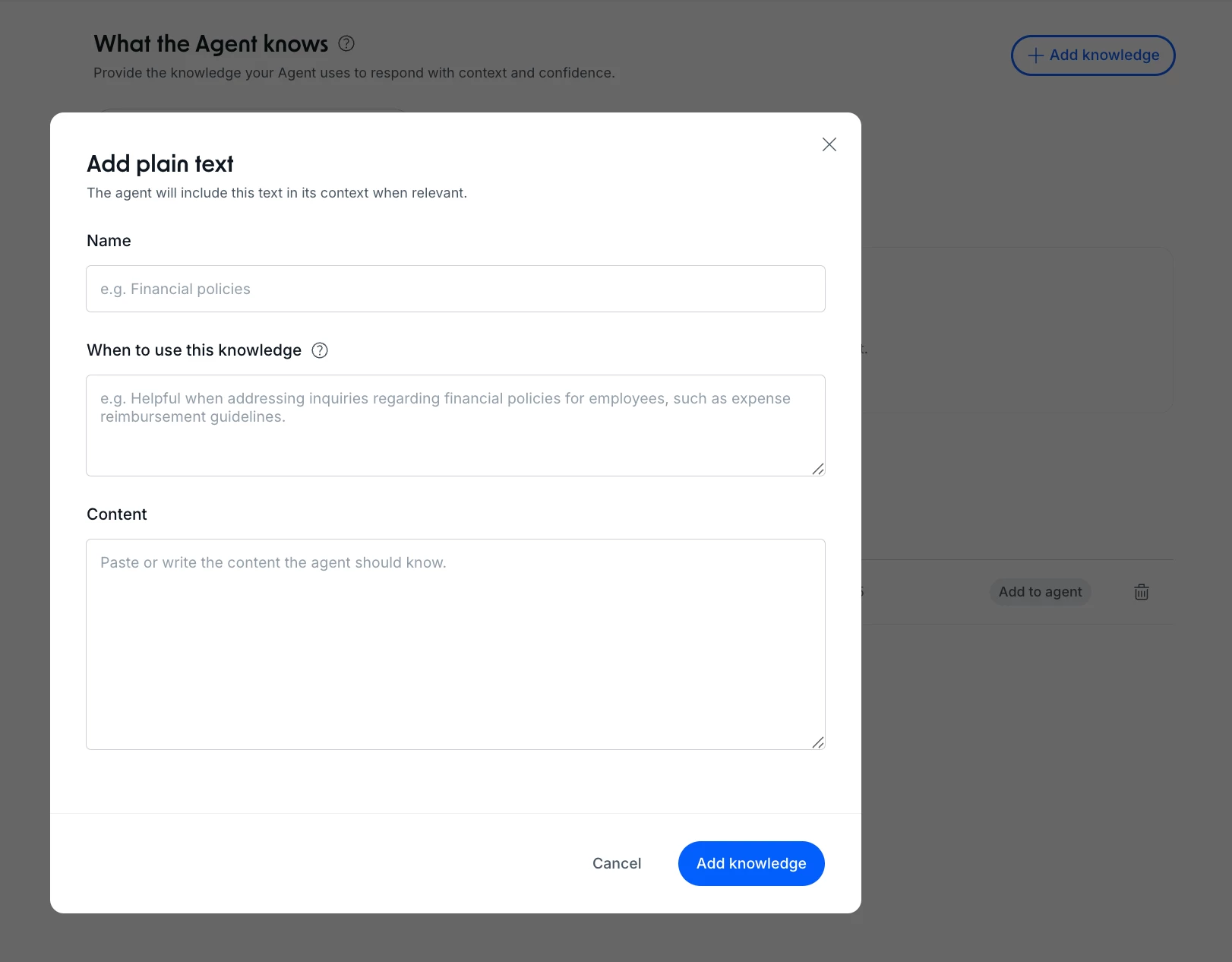
- Text field supports up to 3,500 characters
- Works alongside existing knowledge source types: Documents / PDFs, Pipes / Databases, and Plain Text (new)
How does this help?
- Reduces setup friction: simple rules go straight into the agent, no need to create or manage external files
- Speeds up operational updates: instructions change without any upload workflow or document management overhead
- Centralizes static knowledge: short policies and exceptions live in the same place where the agent is configured
- Improves response quality: plain text processes faster and with higher accuracy than equivalent PDFs
Use cases
- CNPJ blocklists in procurement workflows. An agent validating suppliers references a blocklist maintained directly in the Plain Text field, with no dependency on external spreadsheets or documents. The Procurement team updates it in seconds when needed.
- Reimbursement exceptions in HR. The employee support agent knows, via Plain Text, which expense categories follow special rules (e.g., international travel, medical expenses above a set threshold). It responds accurately without escalating to the team.
- Triage instructions in ITSM. An internal help desk agent receives ticket prioritization rules in Plain Text (e.g., SLA by category, owner by incident type). Consistency is maintained even when policy changes.
- Onboarding context for new processes. When deploying an agent for a recently mapped process, operators add process premises to Plain Text (internal glossary, constraints, known exceptions) before formal documentation is available.
- Short internal policies in compliance workflows. Usage clauses, data restrictions, or approval guidelines that change frequently live in Plain Text and can be updated without involving IT or a document manager.
Most relevant for
- Operators configuring agents without technical support
- Procurement, HR, and ITSM teams with frequently changing operational rules
- Admins who need to iterate quickly on agents already in production
- Customers in early AI Agents adoption with no structured documentation yet
Documentation
For the full step-by-step, check the Help Center article.
