




👤 For pipe members and admins responsible for investigations
🔐 Timeline is available on all plans; configuration reviews depend on permissions
🎯 To reconstruct a card's path and choose the next place to investigate
A request has received the information it needed, yet it remains in the same phase. Before changing a rule or moving it to clear the queue, the team needs to answer a question: which event should have allowed it to proceed, and what happened after that?
By the end of this article, you will be able to reconstruct that sequence and distinguish an expected wait from a case requiring investigation. We will use a reimbursement request that should proceed to approval after its supporting documents have been checked.
What you will learn:
Define the expected transition
Describe the expected behavior with a concrete condition. In this hypothetical example, the request should proceed to approval after document review, provided it meets the company's policy. Identify who or what performs that transition: a person, an automation, or an AI Agent.
That distinction changes the investigation. If a person's decision is still required, establish who owns it and what information is missing. If a rule handles the transition, compare its trigger and conditions with the recorded events.
Record the card, its starting phase, the expected destination, and the approximate time. If the rule changed recently, preserve what was expected when the case occurred. The current configuration alone may not explain an earlier event.
Reconstruct events in Timeline
Timeline is available from the card's Activities area through View timeline. It organizes events chronologically, showing when they occurred and whether they came from a person, automation, or AI Agent. Use this sequence to locate the transition under investigation. The Card Timeline update provides more context for this review.
Read what happened before and after the expected moment. For the reimbursement, check when supporting documents arrived, when their review was recorded, and whether a transition happened later. If the card reached its destination and then returned, include that return in your investigation.
The Help Center guide to Timeline explains the feature. Header indicators can guide your review. Bottleneck identifies a phase worth investigating and is not a precise SLA measurement.
Keep facts and hypotheses separate. “The review was recorded at 2 p.m.” is a fact when the history shows it. “The movement rule should have run after that” is a hypothesis requiring the configuration and relevant execution records.
Compare the history with the process rule
With the pipe admin, compare the observed sequence with the intended trigger, conditions, and destination. Ask whether the required information existed at the relevant time. A field that is complete today does not prove it was complete when the event occurred.
Imagine the review was finished, but information used to decide the next step arrived later. Before changing instructions or rules, clarify how the process should handle that later arrival. The answer depends on the company's process design.
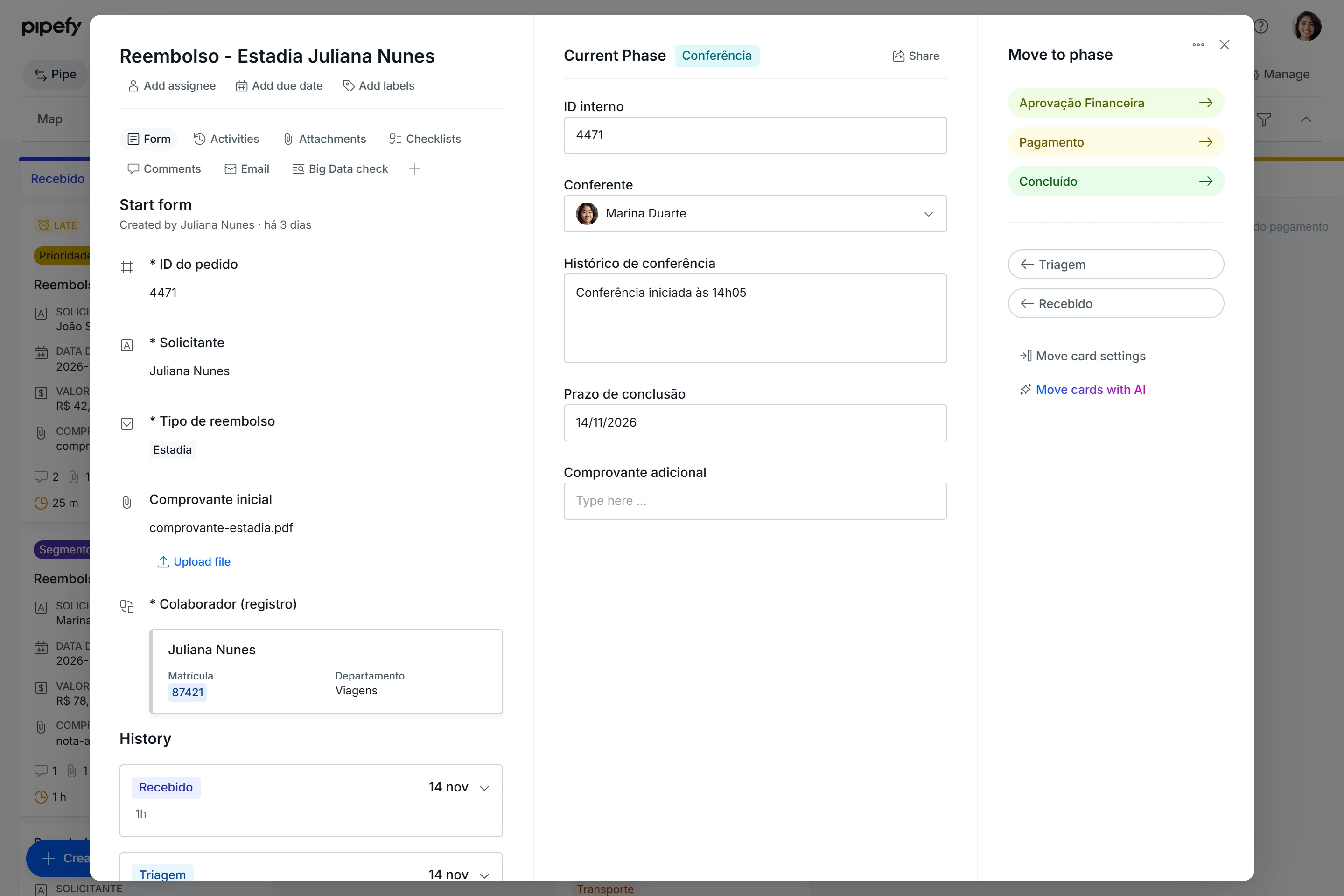
Illustrative card under review. Compare available information and the pending supporting document with the sequence recorded in Activities; the current form does not establish when each value arrived. Example contains Portuguese labels.
Flow helps locate rules and paths associated with a phase. The Orchestration journey connects that structure with card investigation. If an action involves another pipe, also examine the related record with the necessary access. To choose the stage to investigate, read Find bottlenecks along your process.
Follow the evidence to the next investigation
Choose the next record according to the unanswered question. Timeline describes the card's path; other records may be needed to explain a specific execution. If the evidence leads to an AI execution, continue with How to investigate an AI Agent execution. For the broader agent context, see the Execution journey.
- A person still needs to decide: confirm the owner, the decision criterion, and the information required to continue.
- An automation rule is involved: ask the admin to check the applicable rule and execution evidence for the time of the occurrence.
- An AI Agent execution is involved: locate the matching agent and behavior record, using the card and time as references. The Help Center guide to Logs and Tracing, in Portuguese, explains this review.
- The card moved and returned: investigate later events, including the source of the return transition.
A missing entry is not a complete diagnosis. If you cannot confirm an event, check the time period, card, and access with the admin. Record the limitation instead of concluding that an action never happened because it was not found on the first attempt.
Record your conclusion before testing a change
Write the conclusion so another person can verify it: what you expected, what the records show, and what remains unanswered. Include the card link and relevant times so the investigation can continue without relying on memory.
For this hypothetical reimbursement, a useful conclusion would be: “The receipt arrived after the event used to initiate the review. We need to confirm with the process owner how a later update should start a new review.” This identifies the next decision without claiming an unproven cause.
After a change, retest an equivalent case and compare the expected path with the new records. Before repeating an execution, check whether it already sent a message, updated information, or moved a card, so you can assess effects that might be repeated. If you need support, send the evidence and the specific unanswered question.
To explore how goals and rules shape a process, continue with the Process Implementation Certification at Pipefy Academy, taught in Portuguese. You need to sign in or create an account to access the lessons.
Before moving on, confirm that you understand:
☐ You need to identify the condition and owner of the expected transition.
☐ A field's current value does not prove its value at the time of an event.
☐ You can assemble the observed sequence and choose the next record to examine.
Ready to define verifiable results for AI? Continue with Calculations and business rules with AI Agents.
